
News DeskGeopoliticsFlorida Firm Harvests 80 Endangered Sharks for Foreign Aquariums
Verified Curriculum CorpusPublished: Today
Geopolitics·CEFR C2·Mastery

Dynasty Marine Harvests 71 Protected Sharks Through Federal Regulatory Loophole

Article Level ·●C2·Mastery
4 min read·213 words·Audio: 1:47
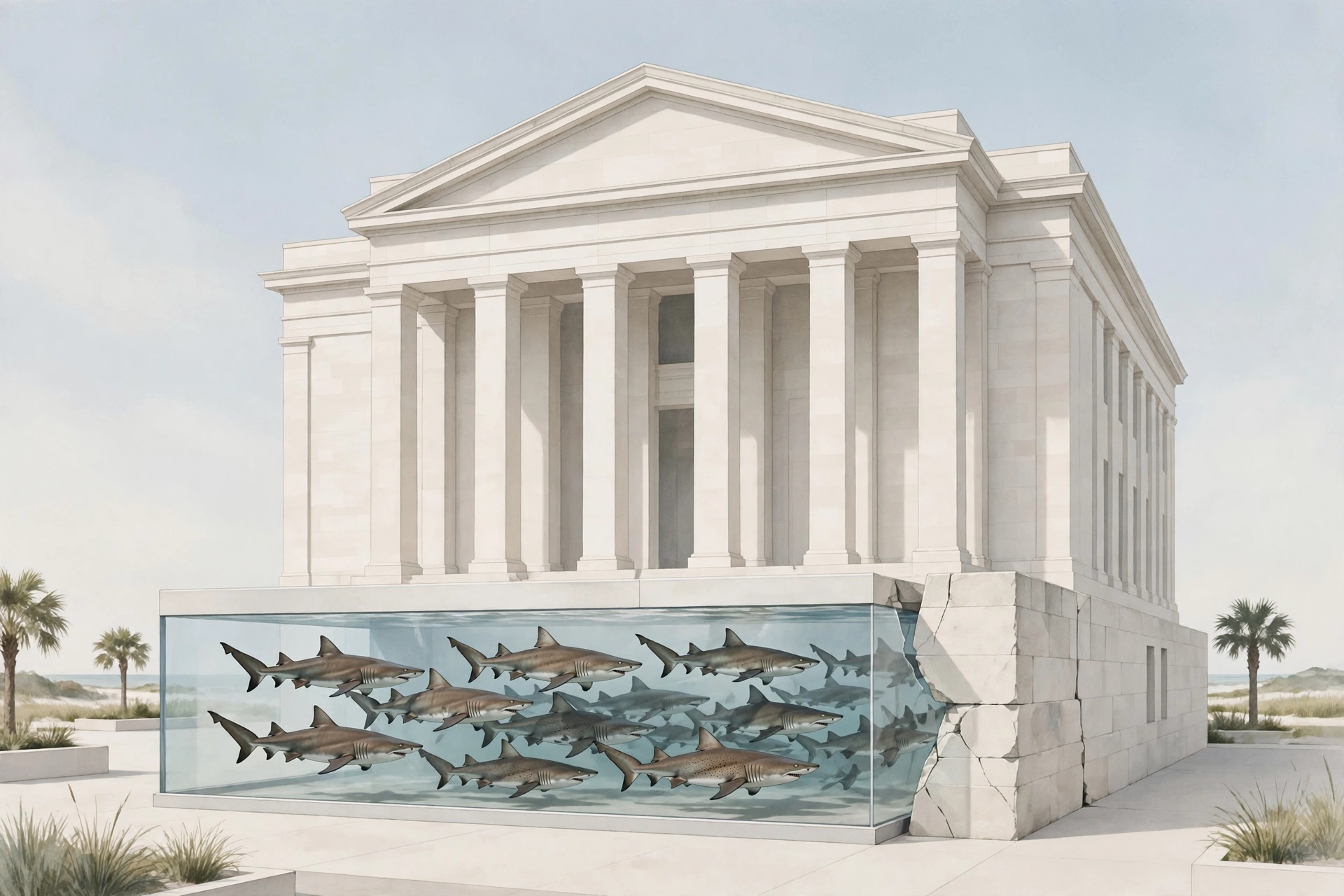
AI-generated illustration (not a photograph) of the setting of this story: Dynasty Marine Harvests 71 Protected Sharks Through Federal Regulatory Loophole
AI-generated with Meta Muse Image on OpenRouter · owned by newstoenglish
Studio Audio Available
Controls floating below ↓
Studio Narration
00:00
01:47

Lesson Overview & Key Takeaways

  • Story Summary: A regulatory gap in US wildlife law has enabled Dynasty Marine, a Florida-based business, to legally remove protected sand tiger sharks from Delaware Bay and ship them abroad. The animals, which take roughly six to ten years to reach breeding age, are now living behind glass in aquariums overseas while federal rules forbid recreational catch of the species in American waters.
  • CEFR Target: Level C2 (Mastery) — calibrated for clear sentence structure and targeted reading fluency.
  • Core Vocabulary: loophole, harvest, surge, extraction, absurdity.
  • Skills Practised: Reading comprehension, dual-accent listening, and contextual grammar.
Reading PassageRead-along: word by word (UK)
100%
Sand tiger sharks are prohibited from capture in United States waters, yet a regulatory permits private firms to collect them legally for the global aquarium trade. Dynasty Marine, a Florida-based operation, 71 sand tiger sharks from Delaware Bay between 2022 and 2024 and logged 35 additional requests in 2025, most destined for China. The scale of has dramatically: a study conducted with three universities documented that annual collection for public display leapt from 2 specimens in 2018 to 40 by 2023, totalling 80 over the full 2018–2024 window. The overwhelming majority of sharks removed from the bay shipped overseas, with China and the UAE absorbing the largest shares, followed by South Korea and Thailand. Researcher Brad Wetherbee drew an analogy that underscored the of the arrangement, comparing the private collection of these protected animals to catching wolves in Yellowstone National Park and selling them to zoos in France or the Middle East. Aaron Carlisle, an associate professor at the University of Delaware, questioned why licensed collectors may remove and functionally these sharks while recreational anglers face legal obligation to release them immediately. Visitors to aquariums in Abu Dhabi now pay up to $100 per day to view sand tigers that will never return to Delaware Bay.

Study this lesson

Activities for CEFR C2, all based on the story above.

1. Vocabulary

Useful words and phrases from the story, with meanings and examples.

Words from the story

5 Target Terms
loophole/ˈluːp.həʊl/
noun · C2

A flaw or gap in a law, regulation, or agreement that allows people to avoid its intended restrictions while remaining technically compliant.

“The new tax legislation was riddled with loopholes that wealthy individuals exploited to shelter billions of pounds offshore.”

Often with: exploit a loophole, close a loophole, regulatory loophole

harvest/ˈhɑː.vɪst/
verb · C2

To collect or remove living organisms, such as fish, timber, or crops, in large quantities from their natural environment.

“Illegal loggers continue to harvest ancient trees from protected rainforest reserves despite international monitoring.”

Often with: harvest wildlife, harvest specimens, harvest request

surge/sɜːdʒ/
verb · C2

To increase suddenly and dramatically in intensity, quantity, or frequency.

“Demand for electric vehicles surged across the market after fuel prices doubled in the winter months.”

Often with: surge dramatically, demand surges, surge in numbers

extraction/ɪkˈstræk.ʃən/
noun · C2

The act of removing or taking something out from its natural location, often implying industrial or large-scale collection.

“Mineral extraction in the region has displaced entire communities and contaminated groundwater supplies.”

Often with: scale of extraction, resource extraction, extraction process

absurdity/əbˈsɜː.dɪ.ti/
noun · C2

The quality of being so unreasonable, illogical, or contrary to common sense that it provokes disbelief or ridicule.

“The absurdity of the policy became apparent when citizens were fined for failing to comply with a rule that did not exist.”

Often with: underscore the absurdity, highlight the absurdity, sheer absurdity

2. Check your understanding

Questions about the story. Answer first; each question explains the answer.

Reading Comprehension

Fact Verification
Passage

Sand tiger sharks are prohibited from capture in United States waters, yet a regulatory loophole permits private firms to collect them legally for the global aquarium trade. Dynasty Marine, a Florida-based operation, harvested 71 sand tiger sharks from Delaware Bay between 2022 and 2024 and logged 35 additional harvest requests in 2025, most destined for China. The scale of extraction has surged dramatically: a study conducted with three universities documented that annual collection for public display leapt from 2 specimens in 2018 to 40 by 2023, totalling 80 over the full 2018–2024 window. The overwhelming majority of sharks removed from the bay shipped overseas, with China and the UAE absorbing the largest shares, followed by South Korea and Thailand. Researcher Brad Wetherbee drew an analogy that underscored the absurdity of the arrangement, comparing the private collection of these protected animals to catching wolves in Yellowstone National Park and selling them to zoos in France or the Middle East. Aaron Carlisle, an associate professor at the University of Delaware, questioned why licensed collectors may remove and functionally harvest these sharks while recreational anglers face legal obligation to release them immediately. Visitors to aquariums in Abu Dhabi now pay up to $100 per day to view sand tigers that will never return to Delaware Bay.

1. What rhetorical function does Brad Wetherbee's analogy serve in the passage?
2. According to the text, what distinction does Aaron Carlisle draw between licensed collectors and recreational anglers?
3. Which statement about the distribution of harvested sharks is directly supported by the text?

Short-Answer Comprehension

Precision Recall

Answer the prompt in a concise phrase or sentence. Your answer will be checked against stored accepted answers, and you can compare your wording with the authentic editorial model response.

3. Practice

Activities with instant feedback. Try each one before you look at the answer key.

Contextual Syntax Drill

Grammar & Tenses

Fill in each blank with the grammatically correct passive or active form of the verb indicated in parentheses.

1. A regulatory loopholeprivate firms to collect sand tiger sharks legally for the global aquarium trade.(present simple, formal register)
2. Annual collection for public displayfrom 2 specimens in 2018 to 40 by 2023, according to the study.(past simple, irregular)
3. Recreational anglersa legal obligation to release captured sharks immediately, unlike licensed collectors.(present simple, contrasting obligation)
4. Sand tiger sharks removed from Delaware Bayoverseas in the overwhelming majority of cases.(past simple, passive implied by context (they are the recipients of the action))

4. Write or speak

A short task in your own words.

Editorial Discussion & Reflection

Spoken & Written Reasoning

Formulate your opinion on these real-world questions. Take brief notes or practice answering out loud.

1. A regulatory loophole permits legal harvesting of a species that is otherwise federally protected. Is the existence of such a loophole itself a form of policy failure, or can it be defended as a necessary exception for economic interests? What principles should guide whether a legal exception is justified?
2. Wetherbee compares shark harvesting to catching wolves in Yellowstone and selling them to foreign zoos. Does this analogy succeed in making the situation seem absurd, or does it oversimplify the differences between terrestrial and marine conservation? Consider whether the analogy's logic holds under scrutiny.
3. Carlisle points out that licensed collectors may harvest these animals while recreational anglers must release them. What does this asymmetry reveal about how legal categories (licensed vs. recreational) can produce outcomes that appear inconsistent with the stated protective intent of the law?

Answer key and explanations

Try the activities first: you learn more by checking your own answers. Then compare.

Frequently Asked Questions About This Lesson

What English proficiency level is this news lesson?

This lesson is calibrated to CEFR C2 (Mastery). It features 213 words adapted from verified journalism, offering an accessible yet authentic challenge for learners.

Does this lesson provide audio pronunciation?

Yes, this lesson includes studio narration in both British (UK) and American (US) accents with real-time word highlighting to improve your listening and pronunciation.

How can I practice with this article?

Read the article at your own pace, listen to the aligned narration, explore highlighted vocabulary definitions in the text margins, and test your understanding with the interactive exercises below the story.