
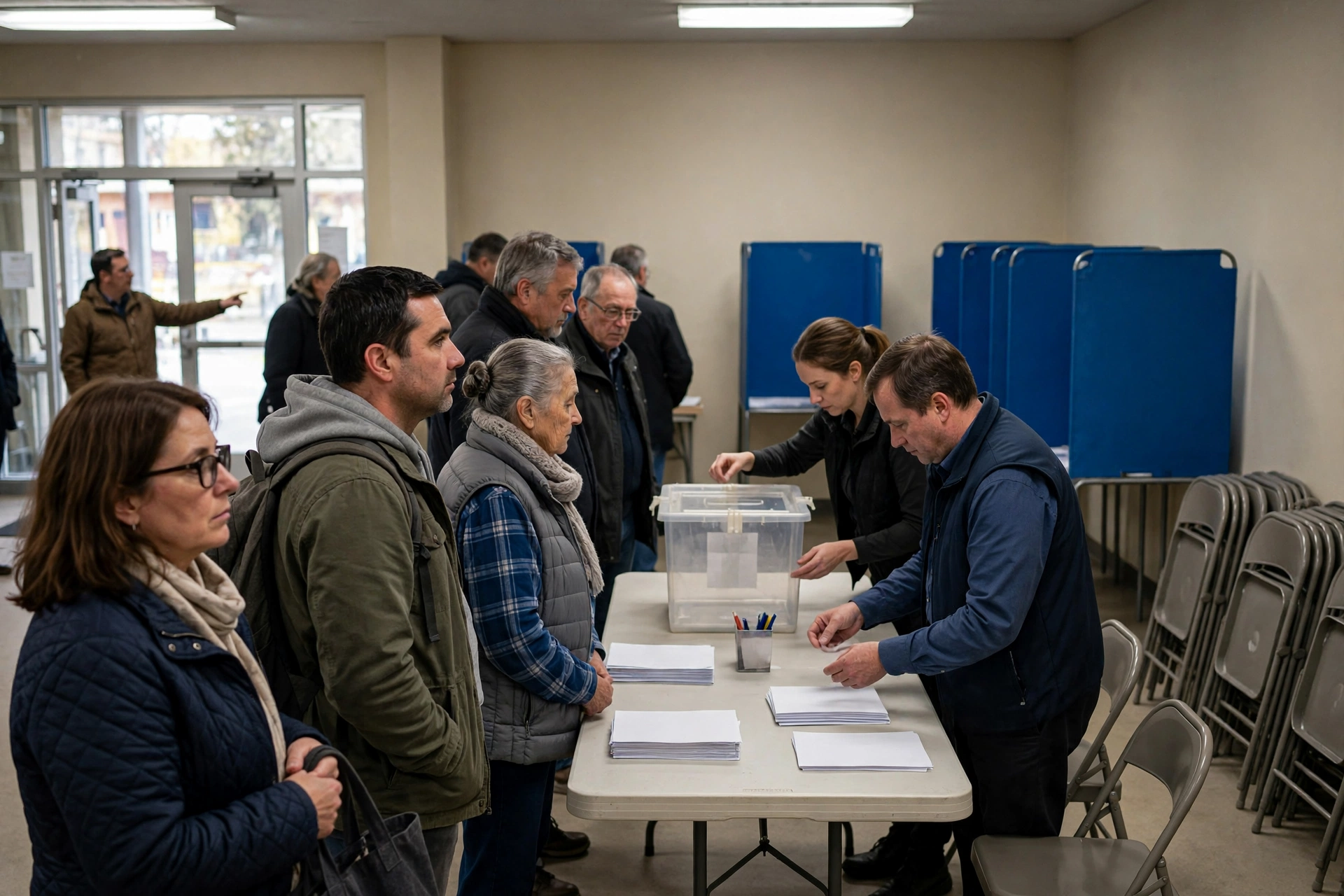
Albertans Vote to Stay in Canada

Lesson Overview & Key Takeaways
- Story Summary: Alberta's first non-binding referendum on separation ended with a clear majority choosing to remain in Canada, strengthening Prime Minister Mark Carney during a US trade war.
- CEFR Target: Level C1 (Advanced) — calibrated for clear sentence structure and targeted reading fluency.
- Core Vocabulary: referendum, binding, riding, tallied, separatist.
- Skills Practised: Reading comprehension, dual-accent listening, and contextual grammar.
Study this lesson
Activities for CEFR C1, all based on the story above.
1. Grammar focus
One structure from the story, explained, with sentences taken from the text.
Relative clauses
noun + who / which / where / whose + more information
Relative clauses (who, which, whose, where) add information to a noun. Defining clauses identify it; non-defining clauses, set off by commas, add extra detail.
- Premier Danielle Smith, who launched the referendum in May, welcomed the early numbers showing broad support for remaining in Canada.
- Conservative leader Pierre Poilievre, who represents an Alberta riding, urged voters not to use the poll to vent frustration at the federal government.

- CBC News called the result once 33% of votes were tallied, at which point 76% backed staying and 23% favoured a binding separation vote.
Notice: Find the noun that each clause describes.
2. Vocabulary
Useful words and phrases from the story, with meanings and examples.
Words from the story
6 Target TermsA public vote in which all eligible citizens decide on a single political question, often whether to change a law or policy.
“Several European countries have held a referendum on whether to join or remain in international organisations.”
Often with: hold a referendum, referendum result, referendum question
Legally required to be obeyed or acted upon; not merely advisory.
“In many legal systems, a contract is only binding once both parties have signed it.”
Often with: binding agreement, legally binding, binding decision
An electoral district in Canada from which voters elect one representative to a legislative body.
“During an election campaign, candidates compete for votes in every riding across the province.”
Often with: represent a riding, Alberta riding, rural riding
Counted or recorded, especially votes or points in a competition or election.
“Once the judges had tallied the scores from all rounds, the winner was announced to the crowd.”
Often with: votes were tallied, tally up, tally results
A person who advocates for a region or group to break away from a larger political entity and become independent.
“Separatist movements have appeared in various parts of the world where ethnic or linguistic differences run deep.”
Often with: separatist leaders, separatist movement, separatist group
The process of making something more varied by adding different types or sources to reduce dependence on one area.
“Investors often pursue diversification to protect their portfolios against losses in any single market.”
Often with: trade diversification, economic diversification, diversification strategy
3. Check your understanding
Questions about the story. Answer first; each question explains the answer.
Reading Comprehension
Fact VerificationShort-Answer Comprehension
Precision RecallAnswer the prompt in a concise phrase or sentence. Your answer will be checked against stored accepted answers, and you can compare your wording with the authentic editorial model response.
4. Practice
Activities with instant feedback. Try each one before you look at the answer key.
Contextual Syntax Drill
Grammar & TensesFill in each blank with the grammatically correct passive or active form of the verb indicated in parentheses.
Lexical Matching Drill
Vocabulary in ContextSelect the matching definition for each target news term extracted from the report.
5. Write or speak
A short task in your own words.
Editorial Discussion & Reflection
Spoken & Written ReasoningFormulate your opinion on these real-world questions. Take brief notes or practice answering out loud.
Answer key and explanations
Try the activities first: you learn more by checking your own answers. Then compare.
Frequently Asked Questions About This Lesson
What English proficiency level is this news lesson?
This lesson is calibrated to CEFR C1 (Advanced). It features 207 words adapted from verified journalism, offering an accessible yet authentic challenge for learners.
Does this lesson provide audio pronunciation?
Yes, this lesson includes studio narration in both British (UK) and American (US) accents with real-time word highlighting to improve your listening and pronunciation.
How can I practice with this article?
Read the article at your own pace, listen to the aligned narration, explore highlighted vocabulary definitions in the text margins, and test your understanding with the interactive exercises below the story.

