
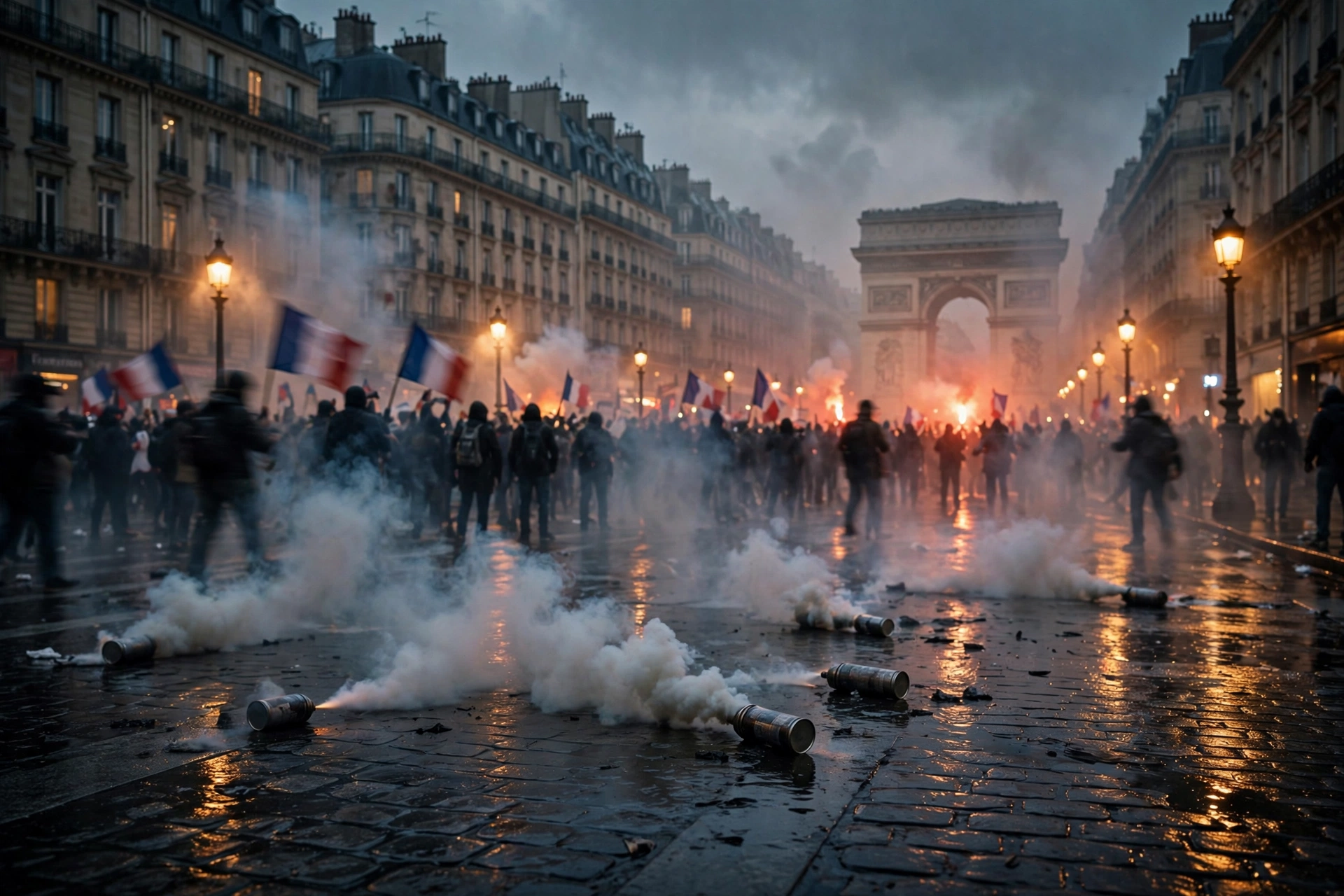
Close to 200,000 People Take to Streets Across France

Lesson Overview & Key Takeaways
- Story Summary: Close to 200,000 people were expected to take part in coordinated nationwide protests in France, the largest mobilisation since the Yellow Vests movement that ran from November 2018 to June 2020. Police used tear gas against demonstrators in Paris and Marseille during clashes, as anger over rising costs and deteriorating school conditions fed into a broader challenge ahead of next year's presidential election.
- CEFR Target: Level B2 (Upper Intermediate) — calibrated for clear sentence structure and targeted reading fluency.
- Core Vocabulary: mobilisation, tear gas, inflation, run-down, inequality.
- Skills Practised: Reading comprehension, dual-accent listening, and contextual grammar.
Study this lesson
Activities for CEFR B2, all based on the story above.
1. Grammar focus
One structure from the story, explained, with sentences taken from the text.
Relative clauses
noun + who / which / where / whose + more information
Relative clauses (who, which, whose, where) add information to a noun. Defining clauses identify it; non-defining clauses, set off by commas, add extra detail.
- The unrest had spread from school demonstrations in poor suburbs of Paris, where teachers were absent and facilities were run-down.
- He also spoke against those who came only to cause damage.
Notice: Find the noun that each clause describes.
2. Vocabulary
Useful words and phrases from the story, with meanings and examples.
Words from the story
5 Target Termsthe act of organising large numbers of people to take action together, often in a protest or campaign
“The union's mobilisation led to a successful negotiation with the government.”
Often with: mass mobilisation, national mobilisation, political mobilisation
a chemical substance released as a cloud by police to force people away, causing eyes to water and breathing to become painful
“Police deployed tear gas to disperse the crowd outside the parliament building.”
Often with: fire tear gas, release tear gas, exposed to tear gas
a general increase in the prices of goods and services over time, which reduces the value of money
“Rising inflation has made it harder for families to afford basic necessities.”
Often with: high inflation, inflation rate, inflation pressure
(of a building or area) in a very bad condition because of age or lack of care or maintenance
“The children studied in run-down classrooms with broken windows and leaking roofs.”
Often with: run-down neighbourhood, run-down facilities, run-down area
a situation in which people are treated differently or do not have the same rights, opportunities, or standard of living
“The report highlighted growing inequality between urban and rural communities.”
Often with: social inequality, income inequality, reduce inequality
3. Check your understanding
Questions about the story. Answer first; each question explains the answer.
Reading Comprehension
Fact VerificationFrance saw one of its largest protest movements in recent years. Police estimated that close to 200,000 people would join the mobilisation across the country. The unrest had spread from school demonstrations in poor suburbs of Paris, where teachers were absent and facilities were run-down. That anger grew into a national movement against inequality and weak public spending. In Paris and Marseille, police fired tear gas during clashes with protesters. President Emmanuel Macron said people could protest but must respect others and their property. He also spoke against those who came only to cause damage. Prime Minister Sebastien Lecornu warned that authorities feared violence. He described France as trapped in a cycle of wars, inflation, and purchasing-power difficulties. Jordan Bardella, leader of the far-right National Rally, said he expected clashes and called it a day of chaos for the country. With the presidential election next year, these events carry clear political weight.
Short-Answer Comprehension
Precision RecallAnswer the prompt in a concise phrase or sentence. Your answer will be checked against stored accepted answers, and you can compare your wording with the authentic editorial model response.
4. Practice
Activities with instant feedback. Try each one before you look at the answer key.
Contextual Syntax Drill
Grammar & TensesFill in each blank with the grammatically correct passive or active form of the verb indicated in parentheses.
Lexical Matching Drill
Vocabulary in ContextSelect the matching definition for each target news term extracted from the report.
Sentence Order & Cohesion
Discourse FlowArrange the scrambled clauses into the chronological, logical order of the news event. Use the arrows to reorder.
5. Write or speak
A short task in your own words.
Guided Writing Practice & Model Comparison
Productive SynthesisWrite a concise summary in your own words (target: 80–130 words). Incorporate the target vocabulary: mobilisation, run-down, inequality, inflation.
Review your draft against each pedagogical criterion before completing the exercise:
Answer key and explanations
Try the activities first: you learn more by checking your own answers. Then compare.
Frequently Asked Questions About This Lesson
What English proficiency level is this news lesson?
This lesson is calibrated to CEFR B2 (Upper Intermediate). It features 152 words adapted from verified journalism, offering an accessible yet authentic challenge for learners.
Does this lesson provide audio pronunciation?
Yes, this lesson includes studio narration in both British (UK) and American (US) accents with real-time word highlighting to improve your listening and pronunciation.
How can I practice with this article?
Read the article at your own pace, listen to the aligned narration, explore highlighted vocabulary definitions in the text margins, and test your understanding with the interactive exercises below the story.

