
News DeskGeopoliticsDrought Pushes Afghan Families to Sell Daughters for Food
Verified Curriculum CorpusPublished: Today
Geopolitics·CEFR B2·Upper Intermediate

Drought in Northern Afghanistan Forces Families to Sell Young Daughters

Article Level ·●B2·Upper Intermediate
3 min read·190 words·Audio: 1:35
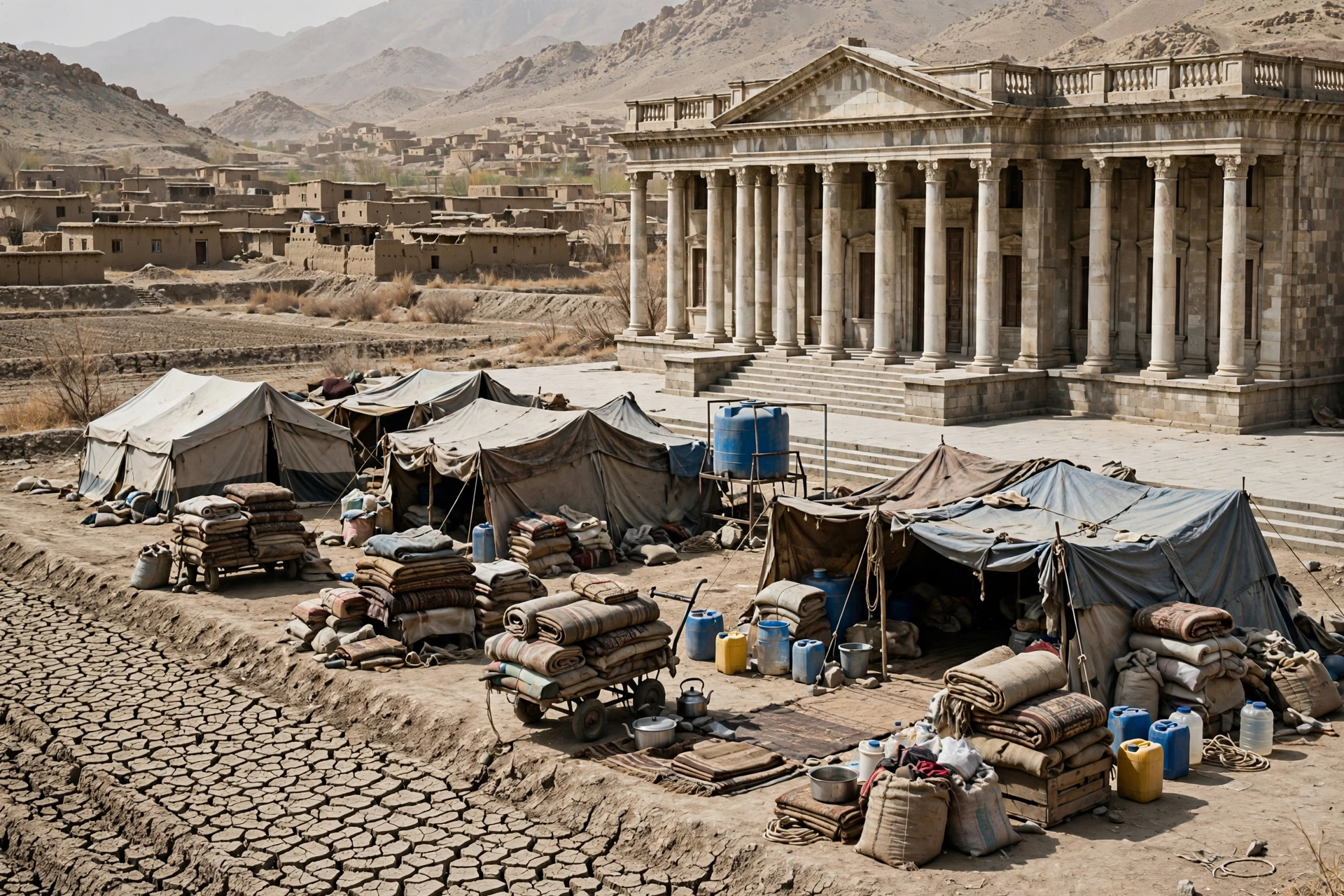
AI-generated illustration (not a photograph) of the setting of this story: Drought in Northern Afghanistan Forces Families to Sell Young Daughters
AI-generated with Meta Muse Image on OpenRouter · owned by newstoenglish
Studio Audio Available
Controls floating below ↓
Studio Narration
00:00
01:35

Lesson Overview & Key Takeaways

  • Story Summary: In Badghis province in northern Afghanistan, repeated droughts have stripped away the incomes of families who depend on rain-fed farming and livestock, forcing some to marry off young daughters to repay debts or buy food, according to reporting on the region's deepening humanitarian collapse.
  • CEFR Target: Level B2 (Upper Intermediate) — calibrated for clear sentence structure and targeted reading fluency.
  • Core Vocabulary: rain-fed, livestock, harvest, displaced, provincial.
  • Skills Practised: Reading comprehension, dual-accent listening, and contextual grammar.
Reading PassageRead-along: word by word (UK)
100%
Climate change has made droughts more frequent and severe in Badghis province, northern Afghanistan. About 95% of residents there depend on farming and for their income. Since 2021, yearly droughts have destroyed and starved animals. A historic drought also hit the province in 2018. Many families now marry off daughters to repay debts or buy food. Thousands by nine years of drought have left their villages for Qala-e-Naw, the capital, but finding work there is often unsuccessful. Some families travel to Herat, Afghanistan's third-largest city, hoping for aid at the Shahrak-e-Sabz camp. That aid has pushing them to sell daughters into marriage to settle debts. Bahahuddin, a father aged 40, sold the kidney of his 10-year-old son Ziauddin for 100,000 afghanis after he could not feed his family through collecting rubbish and begging. Underage brides in the region commonly face domestic violence from in-laws. They are expected to bear children once they reach puberty, adding to maternal death rates already among the world's highest. Most residents of Badghis's villages have no electricity beyond occasional solar batteries and live in mud homes.

Study this lesson

Activities for CEFR B2, all based on the story above.

1. Grammar focus

One structure from the story, explained, with sentences taken from the text.

Present perfect

has / have + past participle

The present perfect links past and present: a completed action with a result that matters now, or a situation that began in the past and continues. It is not used with a finished time such as yesterday.

From the story
  • That aid has run out, pushing them to sell daughters into marriage to settle debts.
  • Climate change has made droughts more frequent and severe in Badghis province, northern Afghanistan.
  • Since 2021, yearly droughts have destroyed harvests and starved animals.

Notice: Find each has / have + participle. What is the result that matters now?

2. Vocabulary

Useful words and phrases from the story, with meanings and examples.

Words from the story

6 Target Terms
rain-fed/reɪn fed/
adjective · B2

(of farming) depending only on water from the sky rather than on irrigation systems

“Many small-scale farmers in semi-arid regions rely on rain-fed crops because they cannot afford irrigation equipment.”

Often with: rain-fed agriculture, rain-fed farming, rain-fed crops

livestock/ˈlaɪv stɒk/
noun · B2

animals that are raised by people on a farm or in the countryside for food, wool, or work

“When the river dried up completely, the villagers could no longer keep their livestock alive.”

Often with: livestock farming, raise livestock, livestock production

harvest/ˈhɑːvɪst/
noun · B2

the process or season of gathering crops from a field

“A sudden frost in October can destroy an entire harvest in just one night.”

Often with: good harvest, failed harvest, harvest season

displaced/dɪsˈpleɪst/
adjective · B2

forced to leave one's home, usually because of war, disaster, or environmental change

“Thousands of displaced families are now living in temporary shelters near the coast.”

Often with: displaced people, displaced families, displaced by drought

provincial/prəˈvɪnʃəl/
adjective · B2

relating to a province or its government, rather than to the national capital

“The provincial authorities announced new rules about water use in rural districts.”

Often with: provincial capital, provincial government, provincial official

run out/rʌn aʊt/
idiom · B2

to use up all of a supply of something so that none remains

“If the charity's funding runs out, the food distribution programme will have to close.”

Often with: aid runs out, supplies run out, run out of food

3. Check your understanding

Questions about the story. Answer first; each question explains the answer.

Short-Answer Comprehension

Precision Recall

Answer the prompt in a concise phrase or sentence. Your answer will be checked against stored accepted answers, and you can compare your wording with the authentic editorial model response.

4. Practice

Activities with instant feedback. Try each one before you look at the answer key.

Contextual Syntax Drill

Grammar & Tenses

Fill in each blank with the grammatically correct passive or active form of the verb indicated in parentheses.

1. Harvests and animalsby yearly droughts since 2021.(past simple passive — the subject is 'harvests and animals', so use 'destroyed' and 'starved')
2. Thousands of peopleby nine years of drought.(past simple passive)
3. The aid at the Shahrak-e-Sabz camp, pushing families to sell daughters into marriage.(present perfect active — use 'run out')
4. Underage bridesdomestic violence from in-laws.(present simple passive — use 'face')

Lexical Matching Drill

Vocabulary in Context

Select the matching definition for each target news term extracted from the report.

rain-fed
livestock
harvest
displaced
provincial
run out

Sentence Order & Cohesion

Discourse Flow

Arrange the scrambled clauses into the chronological, logical order of the news event. Use the arrows to reorder.

1.A historic drought also hit the province in 2018.
2.Since 2021, yearly droughts have destroyed harvests and starved animals.
3.About 95% of residents there depend on rain-fed farming and livestock for their income.
4.Many families now marry off daughters to repay debts or buy food.

5. Write or speak

A short task in your own words.

Guided Writing Practice & Model Comparison

Productive Synthesis
Writing Prompt:

Write a concise summary in your own words (target: 80–130 words). Incorporate the target vocabulary: displaced, harvests, provincial, run out.

Target range: 80–130 words·Current: 0 words
Self-Assessment Checklist Rubric0 of 4 criteria met

Review your draft against each pedagogical criterion before completing the exercise:

Answer key and explanations

Try the activities first: you learn more by checking your own answers. Then compare.

Frequently Asked Questions About This Lesson

What English proficiency level is this news lesson?

This lesson is calibrated to CEFR B2 (Upper Intermediate). It features 190 words adapted from verified journalism, offering an accessible yet authentic challenge for learners.

Does this lesson provide audio pronunciation?

Yes, this lesson includes studio narration in both British (UK) and American (US) accents with real-time word highlighting to improve your listening and pronunciation.

How can I practice with this article?

Read the article at your own pace, listen to the aligned narration, explore highlighted vocabulary definitions in the text margins, and test your understanding with the interactive exercises below the story.