News DeskGeopoliticsSubmerged Stone Tools Reveal Ancient Movement Off the Pilbara Coast
Verified Curriculum CorpusPublished: Oct 16, 2026
Geopolitics·CEFR C2·Mastery

Submerged Stone Tools Reveal Ancient Movement Off the Pilbara Coast

Article Level ·●C2·Mastery
3 min read·160 words·Audio: 1:31
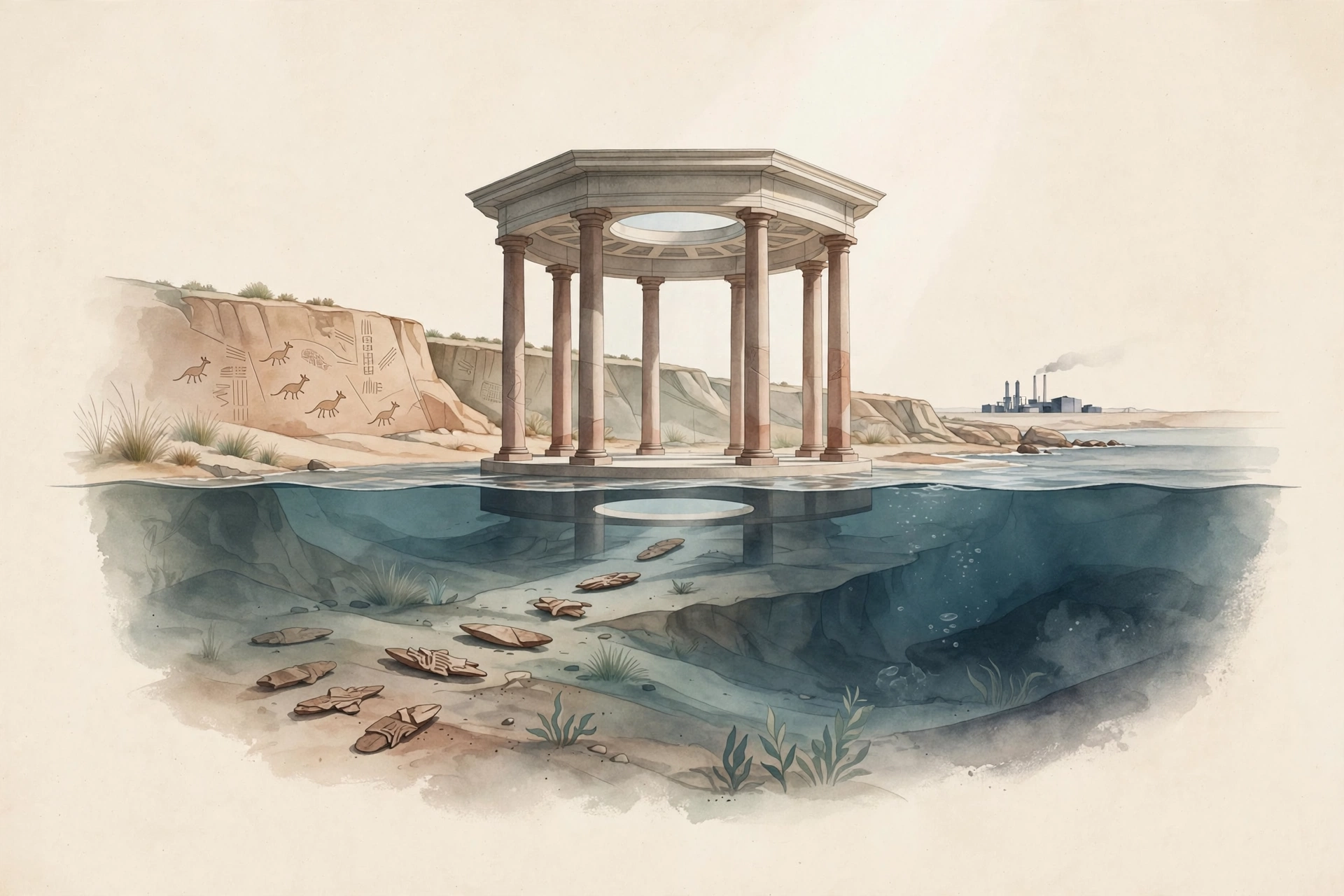
AI-generated minimal editorial illustration (not a photograph): Submerged Stone Tools Reveal Ancient Movement Off the Pilbara Coast
AI-generated with Meta Muse Image on OpenRouter · owned by newstoenglish
Studio Audio Available
Controls floating below ↓
Studio Narration
00:00
01:31

Lesson Overview & Key Takeaways

  • Story Summary: Indigenous rangers and archaeologists jointly recovered over 20 submerged stone artefacts near the Burrup Peninsula, exposing long-distance tool transport while the same shoreline hosts Western Australia's oil and gas hub.
  • CEFR Target: Level C2 (Mastery) — calibrated for clear sentence structure and targeted reading fluency.
  • Core Vocabulary: pinpointed, juxtaposing, custodianship, sedimentation, submerged.
  • Skills Practised: Reading comprehension, dual-accent listening, and contextual grammar.
Reading PassageRead-along: word by word (UK)
100%
Researchers have two previously undocumented underwater archaeological sites off the Burrup Peninsula in Western Australia's Pilbara region, recovering more than 20 stone artefacts from terrain. Some of those artefacts originated from locations 20 to 25 kilometres distant, indicating that ancient inhabitants transported tools across what is now a archipelago. The collaborative effort united archaeologists with Indigenous rangers from the Murujuga Aboriginal Corporation, including Malik Churnside and Richard Variakojis, who are listed as co-authors of the published paper. Underwater investigation in this coastal zone commenced in 2019, building on earlier survey work, and researchers believe the seabed may harbour thousands of additional sites awaiting exploration. Yet the peninsula simultaneously functions as a major hub for Western Australia's oil and gas industry, millennia of cultural with the mechanical pulse of nearby industrial plants. The discovery underscores how landscapes preserve human narratives invisible from shore, and how Indigenous can reshape archaeological practice from the seabed upward.
Study this lesson

Activities for CEFR C2, all based on the story above.

1. Vocabulary

Useful words and phrases from the story, with meanings and examples.

Words from the story

6 Target Terms
pinpointed/ˈpɪnpɔɪntɪd/
verb · C2

To identify or locate something with great precision, often after a period of searching or analysis.

“After months of satellite analysis, the team pinpointed the exact coordinates of the buried structure.”

Often with: pinpointed the location, pinpointed the cause, precisely pinpointed

juxtaposing/ˌdʒʌkstəˈpəʊzɪŋ/
verb · C2

Placing two things close together so that their differences or contrasts become strikingly apparent.

“The exhibition juxtaposes traditional craftsmanship with digital fabrication to provoke reflection on what counts as art.”

Often with: juxtaposing two ideas, juxtaposing past and present, starkly juxtaposing

custodianship/ˌkʌstəʊˈdiənzʃɪp/
noun · C2

The responsibility for the careful protection, maintenance, or guardianship of something of cultural, historical, or ecological value.

“The museum transferred custodianship of the collection to the community it originated from.”

Often with: Indigenous custodianship, exercise custodianship over, custodianship of heritage

sedimentation/ˌsedɪmɛnˈteɪʃən/
noun · C2

The gradual process by which particles settle and accumulate in layers over time, often used metaphorically to describe slow cultural or historical accumulation.

“The novel treats memory as a form of sedimentation, each generation depositing its residues on the last.”

Often with: cultural sedimentation, layers of sedimentation, process of sedimentation

submerged/səbˈmɜːdʒd/
adjective · C2

Completely under the surface of water; also used figuratively to describe something hidden beneath visible reality.

“The documentary revealed submerged communities whose voices had never reached the public sphere.”

Often with: submerged landscape, submerged terrain, submerged beneath

drowned/draʊnd/
adjective · C2

Covered or flooded by water so as to be invisible above the surface; used poetically to evoke landscapes once above sea level.

“The cartographer traced the outlines of a drowned coastline from ancient oral histories.”

Often with: drowned archipelago, drowned landscape, drowned valley

2. Check your understanding

Questions about the story. Answer first; each question explains the answer.

Reading Comprehension

Fact Verification
Passage

Researchers have pinpointed two previously undocumented underwater archaeological sites off the Burrup Peninsula in Western Australia's Pilbara region, recovering more than 20 stone artefacts from submerged terrain. Some of those artefacts originated from locations 20 to 25 kilometres distant, indicating that ancient inhabitants transported tools across what is now a drowned archipelago. The collaborative effort united archaeologists with Indigenous rangers from the Murujuga Aboriginal Corporation, including Malik Churnside and Richard Variakojis, who are listed as co-authors of the published paper. Underwater investigation in this coastal zone commenced in 2019, building on earlier survey work, and researchers believe the seabed may harbour thousands of additional sites awaiting exploration. Yet the peninsula simultaneously functions as a major hub for Western Australia's oil and gas industry, juxtaposing millennia of cultural sedimentation with the mechanical pulse of nearby industrial plants. The discovery underscores how submerged landscapes preserve human narratives invisible from shore, and how Indigenous custodianship can reshape archaeological practice from the seabed upward.

1. What does the phrase 'juxtaposing millennia of cultural sedimentation with the mechanical pulse of nearby industrial plants' primarily convey?
2. According to the text, what can be inferred about the relationship between the artefacts and the landscape?
3. What is the author's implied stance on Indigenous involvement in the research?

Short-Answer Comprehension

Precision Recall

Answer the prompt in a concise phrase or sentence. Your answer will be checked against stored accepted answers, and you can compare your wording with the authentic editorial model response.

3. Practice

Activities with instant feedback. Try each one before you look at the answer key.

Contextual Syntax Drill

Grammar & Tenses

Fill in each blank with the grammatically correct passive or active form of the verb indicated in parentheses.

1. The team, working alongside Indigenous rangers,more than 20 stone artefacts from submerged terrain.(past simple)
2. The discovery underscores how submerged landscapeshuman narratives invisible from shore.(present simple (generic))
3. Having commenced in 2019,earlier survey work, the underwater investigation continues to yield new sites.(present participle (perfect participle phrase))
4. Researchers believe the seabed maythousands of additional sites awaiting exploration.(bare infinitive after modal 'may')

4. Write or speak

A short task in your own words.

Editorial Discussion & Reflection

Spoken & Written Reasoning

Formulate your opinion on these real-world questions. Take brief notes or practice answering out loud.

1. The passage juxtaposes submerged cultural heritage with active oil-and-gas industry on the same peninsula. To what extent should co-located industrial activity constrain future archaeological exploration, and who should decide those boundaries?
2. The text states that Indigenous custodianship can 'reshape archaeological practice from the seabed upward.' Does naming Indigenous collaborators as co-authors constitute a fundamental epistemological shift, or is it a procedural accommodation within an unchanged discipline?
3. The author describes the submerged landscape as preserving 'human narratives invisible from shore.' How might this metaphor challenge or extend the way we think about whose history gets recorded and whose remains visible?

Answer key and explanations

Try the activities first: you learn more by checking your own answers. Then compare.

Frequently Asked Questions About This Lesson

What English proficiency level is this news lesson?

This lesson is calibrated to CEFR C2 (Mastery). It features 160 words adapted from verified journalism, offering an accessible yet authentic challenge for learners.

Does this lesson provide audio pronunciation?

Yes, this lesson includes studio narration in both British (UK) and American (US) accents with real-time word highlighting to improve your listening and pronunciation.

How can I practice with this article?

Read the article at your own pace, listen to the aligned narration, explore highlighted vocabulary definitions in the text margins, and test your understanding with the interactive exercises below the story.